
Jamming with Bobby Cochran
- Nick Hutchinson
- Sep 17, 2015
- 21 min read

A master of the six string, Bobby Cochran has played alongside some of classic rock’s greatest performers. Known for his inspired lead work with artists including the Flying Burrito Brothers, Steppenwolf, Leon Russell, and the Grateful Dead’s Bob Weir, Cochran is also the nephew of rock & roll innovator and rockabilly artist Eddie Cochran of “Summertime Blues” fame. Bobby’s playing is rooted in country, surf style, blues and good old rock & roll. His expansive approach never fails to complement the sound of whatever band he’s playing in and takes the music to its highest level. After his steady touring days in the ’70s, ’80s and ’90s he grew weary of the crime in Southern California and relocated his family to Nashville, TN. His story is a tale of moving in search of opportunity and seeking to overcome some of life’s most challenging obstacles. An inveterate gear tinkerer and a practitioner of the martial arts, he developed a unique spirituality and worldview while touring the planet and performing. In addition to playing in his own outfit (he has different iterations of his band in Nashville, Southern California, Sweden and the U.K.), Bobby, who has produced many artists, works as a recording and musical equipment consultant, teacher, clinician and life coach. Cochran is currently working on a book that he hopes will illuminate the nature of love, spirituality and the purpose of life.
TipJar: Let’s start at the beginning. When did you first start playing the guitar?
Bobby Cochran: I first picked up the guitar when I was twelve and a half. It was a couple years after my uncle Eddie [Cochran] died. My dad [Bob Cochran] had a little acoustic guitar sitting in the backseat of his car and we were parked at a drive-in movie. I heard a western melody come over the speaker [scats out the guitar line to “Bonanza”] and I started picking along. I thought to myself, hey I can do this! That night I asked my dad to teach me how to play. He taught me some basic chords and I was hooked. Shortly after that he went on a drinking binge for a few days and all I could think of was how much I wanted him to come home so that he could show me how to tune that guitar.
So your father was a drinker?
Yes, he had a problem. My Uncle Eddie did too. It ran in the family. It was difficult to grow up around. They were very intelligent and talented individuals who just had some deep pain. As a result, I made a commitment to myself to steer clear of drinking and drugs. I believed I needed to honor my life, honor my health and honor my talent. I was also very prayerful. I have always preferred to be as present as I can in life. My indulgence was music. I immersed myself in practicing the guitar. My father passed away at the age of 50 from alcoholism. He was a brilliant man, very gifted, smart, handsome and he died from alcoholism. It was frustrating and heart-breaking.
And obviously you stuck with the guitar once you learned those first few chords . . .
Yeah, I played as much as I could. I was given a certain gift to start with, and I also practiced very hard. Other than swapping licks with friends, I was self-taught. I made a commitment to practice every day. Once I woke up around 1:00 a.m. and realized that I hadn’t practiced that day, so I grabbed my guitar and started playing in the middle of the night. When I woke up the next morning I was still holding the guitar. I missed a lot of school partially because of my devotion to music. According to my old report cards I actually missed more school than I attended, from the 4th grade on. The school officials sent me to continuation, which is where they put all the pregnant girls and social misfits who didn’t conform to how they thought we needed to be. I was talking to the principal one day and he said “Oh I didn’t know you played guitar, did you know we have a guitar class here?” First of all I was stunned that he didn’t know that I played guitar, because I would leave school to go touring from time to time and I basically fit school around my gigging schedule. It wasn’t that big a school and it was a pretty small community. I figured he knew what his students were into. So having heard that, I went down to the guitar class where the teacher (George M. Smith) asked me to play for him. I was 16 or so at the time. After listening to me play, he had me teach the next class (laughs). I remember telling the principal after that — hey you have a guitar class here and I could have been earning credits towards my graduation by playing guitar? Are you serious?!
Where did you live at that time?
I lived in Southern California. I was born in Albert Lea, Minnesota, and when I was about two years old, my family moved out to Bell Gardens [in the greater Los Angeles area]. We followed my uncle Eddie and the rest of the Cochran family out to California. Originally, the Cochrans were all from Oklahoma City. Lots of Okies and country music pickers had relocated to the West Coast. I was in some great local bands there. My first group started in junior high. We put a little outfit together to play the talent show. It was just a guitar, a tenor sax and a snare drum as our piano player had quit right before the show. You can imagine what a disjointed thing it was when you lose a major instrument like the piano that helps carry the songs with chords and bass lines (laughs). One of the songs we performed was Milk Cow Blues, which is a song my uncle had played.
After that show, the sax player and I immediately went on to form our first real band, Kelly and the Midniters. We gigged mostly around Orange County. I was living in Cypress at the time. Guybo (Conrad Smith), Eddie’s bass player, used to let us borrow his amp and Fender bass, since our bass player was actually a guitar player and didn’t own a bass rig. We promoted our own shows and practiced in the garage. Not too long after that, when my family moved to Long Beach and then Cudahy, I joined Benny and the Midniters, which became Little Willie G and Thee Midniters. These were very popular bands from East L.A. and they were my first professional groups. It’s where I got my first introduction to playing rhythm and blues as well as Chicano rock. Among other gigs, we played a lot of big Mexican weddings. Having a Chicano band with a Caucasian surf guitar player in it was revolutionary. It was really outside the box. We were breaking down musical and racial barriers. They’d come down to Cudahy and pick me up then drive me into the heart of East L.A. for practice, where I was the only white boy around (laughs). Interestingly, my uncle Eddie had been friends with Richie Valens [of La Bamba fame]. I was told that Richie actually got a Gretsch guitar just like the one Eddie had because he admired Eddie. Anyway, that band broke through some cultural barriers and we included some surf music in our sets, which was not a common thing in East L.A. We competed against another popular East L.A. band called the Blue Satins at the Battle of the Bands in 1963 and we did really well.

(Little Willie G and Bobby at the Battle of the Bands in 1963)
Later the drummer, Danny LaMont [from Thee Midniters], and I went on to form the Vesuvians, which played early surf music. Our business cards read “The erupting sounds of the Vesuvians!” We played gigs like the Teenage Fair at the Hollywood Palladium, which was a pretty big deal. It was my first supergroup (laughs). I was only 14, so it’s pretty funny that I was thinking that way at such a young age, but we had a hell of a good band. I’ve always had a certain energy to my playing that has carried throughout my career. I’m enthusiastic about things that I’m really into. Given that I also played with Bobby and the Midnites, it’s clear that I had a midnights theme running through my life too.
What is a midnighter?
Someone who stays up late. A midnight rambler, a carouser. You know, musicians are always up late, playing a gig and then an after show jam, or what have you. A midnighter would be someone who is up and about around the midnight hour. The first great band to use the name that I can remember was Hank Ballard and the Midnighters, who I eventually met and became friends with. I think they inspired the use of the name.
Who were some of your main influences?
I liked my uncle Eddie’s music a lot and I had access to lots of his recordings that no one else had, but my first albums were by Chet Atkins, the master of the Nashville sound, and Duane Eddy, who was the king of the twang guitar. He was known for great old tunes like “Rebel Rouser,” “40 Miles of Bad Road,” and “Cannon Ball.” With Atkins it was mostly like how does he do that?! Duane’s style I could actually access. I got to meet him once and I told him how much he had influenced my playing. His tone and melody were amazing. He had a big impact on me as a young player. I also liked Buck Owens and his guitarist Don Rich, who I actually got to meet once at Capitol Records. And some of Eddie’s friends showed me some stuff after he passed away. Dad and I would go to Hollywood to visit Eddie’s girlfriend [Sharon Sheeley]. Jackie DeShannon was visiting and she taught me this G to C thing she did that’s still a part of my playing. Her charisma and enthusiasm wore off on me too. She turned me on to B.B. King, saying, “Your uncle really liked this guy, and he would be great to listen to.” Jackie actually made an appearance with Little Willie G and Thee Midniters. That was my foundation. When I finally got to meet B.B. and Mike Bloomfield one night I got a chance to talk about their vibrato techniques with them. That was a huge thrill. I also got to know James Burton, who was another friend of my uncle. I always liked his playing and we eventually became friends.
Do you remember much about your uncle?
Well, I was 10 when he died, but I did get to hang out with him a little. One of my most vivid memories was when he, my dad and I were lying on our backs in the back yard at my aunt’s house. I was lying down next to Eddie and we were all looking up at the sky. I remember that a bunch of coins slid out of his pockets. I said, “Hey Uncle Eddie you dropped these, you dropped your money.” He said, “Oh thanks, you can keep those. That money is for you.” He was a really generous man. He was almost generous to a fault. Sometimes he would run out of money in the middle of a tour because he was buying people dinners and not paying attention to his financial situation. He was the baby of his family and he was like a god in our family. He died at the age of 21. I wrote a book about his life, through my eyes. [ Three Steps to Heaven: The Eddie Cochran Story. Published in 2003]. I also remember looking at him one morning when he was walking around my grandparents’ house and I remember thinking, “Wow that man’s hair is really messed up.” (laughs) I think I was about four years old at the time. He used to slick his hair back and I remember there being a grease spot on the head rest of the chair where he used to sit.
Being a musician and following in his footsteps, how did it feel to be related to a legend of early popular music?
Sometimes it was tough because people compared me to him and wanted me to sound like him and I just wanted to be myself, but he’s definitely a huge part of who I am on both a musical and spiritual level. After he passed away I would have lucid dreams in which he would spend time with me and teach me how to play guitar. We were able to relate to each other through these dreams. Our communication was more telepathic. I kind of saw myself through him. I couldn’t always remember the details of what he showed me in these dreams, however it was as if the guitar just made sense as it unfolded and I seemed to understand it. The dreams helped me to understand him and learn about the magical connections we have available to us. They were a powerful influence for me, and they seemed far more real than being awake during life itself. I made a commitment to myself to be a great guitar player because of him and how much I admired him. He was an extraordinary guy, and he had it all. I was very prayerful and dedicated in those days. I was fortunate that I got to stand on his shoulders so to speak. He contributed to the spiritual roots of my artistic development.

(Eddie Cochran and Sharon Sheeley)
Can you share a little bit about your father’s influence on you?
My dad was also a big part of my early development. He ran a recording studio called Advanced Recording Studio that was pretty cool. We had guys from Cal’s Corral and the Squeakin’ Deacon Talent Show showing up to record. At a young age I basically became his staff guitarist. I was able to live and breathe guitar. His studio was great because it gave me an opportunity to play with a lot of excellent players. Del Shannon, who wrote “Runaway” showed up once, and there would be some amazing old country pickers dropping by. These old guys could really rip. Our area was a mecca for Okies. California was a place that provided opportunities in the film and music industries that they never could have found back in Oklahoma. It was an environment that afforded people the possibility of being discovered. The music industry has traditionally been centered in New York and Nashville, but L.A. had a lot of radio stations that were a big deal. It provided tremendous opportunity for budding artists. My dad also forced me to sing. I became a singer kicking and screaming. I was really embarrassed to sing when I was young. I had a high pitched voice like Mickey Mouse, but he made me do it anyway. And thanks to that I developed my voice and learned how to sing lead and harmony parts. I didn’t like being pushed at the time but I appreciate that he did push me because it forced me to get out of my shell. I also give a great deal of credit to my mom who was trained as an opera singer. She loved blues and jazz and introduced me to lots of great artists, like Lionel Hampton, Gene Krupa, Frankie Laine, Eartha Kit, Kay Starr and Ray Charles. My uncle thought enough of her voice that he cut some demos to present her as an artist in the vein of Julie London. A CD was later released of her recordings on one of my uncle’s discs. She would have been so proud to be on a CD with Eddie. My Dad also urged me to push my guitar skills. He didn’t like what he called single-string players, who just used one string to play parts. He wanted me to learn how to use multiple strings, like Eddie, so that I could take it to the next level.
How would you describe your style of guitar playing?
I play a little bit of everything. I started off in folk and country music and then moved into surf style and the blues and onto rock & roll and R&B, but I like to play a variety of music. The one style that I don’t really consider myself playing is jazz, but I do play a lot of very intricate chord sequences and some sophisticated voicings and stuff. The first time that Billy Cobham, Alphonso Johnson and I played together, I had never heard them play before as we had only met for dinner, but we were able to step up and play twelve 40-minute-long shows together for the Music Messe Frankfurt Trade Fair [the European version of NAMM] in Frankfurt, Germany in 1978, that were amazing. I’d throw out a riff or a rhythm feel and everyone would pile on and improvise on it. I’ve had people stop me decades later to tell me that it was some of the best music they’d ever heard in their lives. It was totally spontaneous. The next time we played together Bob Weir was a part of the lineup and we introduced actual songs, but at first I was just [free-form] jamming with Billy and Alphonso. I play best when I’m manifesting something that’s coming through me, when I’m connecting. At its best, it’s like channeling. With Weir that was definitely the situation. The music we played really allowed for the possibility of connecting and feeling. It was great chemistry.
A lot of guitarists think it’s all about having murderous chops. And yeah, technique is important, but the best playing is inspired. It’s about the spaces in between the notes. A lot of guitar players learn a bunch of licks and then string those licks together. That is not necessarily music. When I play, it’s more spontaneous. Sure, I use some licks, however it’s more like singing a spontaneous melody.
Has your playing changed a lot over the years?
Oh yeah, my style has evolved tremendously. My equipment has evolved as well. I play a lot more acoustic now, which has allowed me to discover another side of my playing. I like to record finger style loops and then solo over those. I’ve been accepted by the finger style crowd. I am part of a group called the Chet Atkins Appreciation Society. I use a hybrid set of strings for a rock and roll acoustic approach, La Bella puts the custom sets together for me. I have always used a hybrid picking style. I used to combine thumb picking with flat picking, but I stopped practicing with a thumb pick while I was with the Burrito Bros. I realized I would never become as good as I wanted when I always switching between those styles. So since I made most of my money with a flat pick, I decided to put away the thumb picks and concentrate on my hybrid style using a flat pick and my fingers.
Why did you start playing the acoustic guitar?
I always played acoustic on sessions, however seldom live. After my daughter Bree died [Cochran’s daughter, Breeannon Mikalia, passed away in 1999 in an automobile accident. Like her great uncle, she died at the age of 21 and on the same day, April 17, and at almost the same time of day], I found myself playing the acoustic guitar that she had bought before her death. I was doing a lot of crying and just introspectively noodling, daydreaming, pondering life and processing the loss. Ironically, I wound up writing a bunch of happy sounding songs on the acoustic guitar. It was a way for me to process my sorrow and pain. It was a time that helped clarify the issue of love, loss, and life for me. Love resonates through everything. It’s the best, most precious part of life. Music helps to give us access to our emotions. Watch a movie with the music turned off and you will see how flat it is without the music. Music is an extraordinary gift to the world and it deserves to be honored and recognized for its transformational qualities.
You’ve been very involved with the gear and equipment side of playing over the years, from guitars, amps and effect pedals to recording software. How’d you get into all of that and is it that something that you enjoy doing?
Oh yeah. I’ve been hot-rodding guitars and working on pedals and equipment since I first started playing. When I was just a young teenager I’d go down to Cal’s Corral to hear all the great country artists play. I first discovered fuzz tone on a steel guitar down there. My first fuzz tone pedal was a Gibson Maestro. I later discovered much better fuzz tone effects, but I remember being blown away by that at the time. It sounded like the steel player was using it to emulate a saxophone. I took it apart to see what was in it. And then I built one. I was always modifying my guitars. I installed pickups and worked on my own guitars from the time I started playing. That type of hot rodding runs in the family. Eddie altered his guitars and amps and my dad built hot rods and raced them in the middle and late ’50s. Dad created what was possibly one of the first weed eaters, by taking an old upright vacuum cleaner apart and screwing hack-saw blades to the arbor. He cut our back yard grass which was about two feet high. It was amazing! I began testing guitars and effects for Fender at the age of 15. They would ask me to check out an amp and report back and I would come back with a list of 30 things wrong (laughs). I tested the rosewood Tele that went to George Harrison during the Let it Be era and a rosewood Strat for Jimi Hendrix, but he died before they could present it to him. Out of my interest in hot rodding guitars I got into helping design and test equipment of all types. I’ve worked with Fender, Yamaha, Ampeg, Ibanez, Peavey, Presonus, Digitech, Cakewalk, La Bella, D’Andrea, Patrick James Eggle, Montarado Guitars, RMC, San Greal, and lots of other companies. I was never normal. Even at a young age I would always sit down with adults and talk about designing guitars, effects and life.
You seem to have a high standard for sound and tone.
Indeed, whenever I play I arrive ready to sound my best. I bring the best gear I can so that I can produce the best possible sound. I show up expecting [Paul] McCartney to be there (laughs). I want my sound to be sweet. I’m ready and willing to bring whatever gear it takes. Lately I’ve been playing my acoustic stuff through an amazing SanGreal amp. My guitar is set up with a nice Earvana nut. And I usually add some compression, delay and reverb to my sound.
What are some of your favorite guitars?
I’ve had so many great guitars. They all have their own language. I played a Gretsch 6120 for a while. I loved it, but I couldn’t turn it up as loud as a Tele. You had to play differently on the Gretsch. And I’ve had some nice Teles [Fender Telecasters], including a ’52 and a ’56. Both were really good. Once I started playing a Tele I had to change how I played, and that change made me blossom. For a long time I had a dark spot on my right hip where my Tele rode. Then I swapped and started playing my Ibanez, the cowboy fancy model that many people recognize from my period of time playing with Bob Weir. I modified that guitar to try and get some of that Tele sound out of it. And lately I’ve been playing acoustic guitars. And of course I modified a lot of my guitars in the past. They weren’t sacred to me. Though my outlook on that has changed a bit recently.
How’d you come to link up with Bob Weir?
I was good friends with the guitar builder Wayne Charvel. He and I used to spend a lot of time in his shop [in Azusa, CA] where we would work on guitars together. While I was in his shop one day an Ibanez rep, Kim Johnson, came in. Wayne introduced me to him and we got to know each other a little and he asked me if I’d be interested in evaluating some stuff for Ibanez. In particular we discussed a sliding pickup mechanism that they were working on at the time. I told him what I saw as the problems. I’d been doing R&D [research and development] for years with Bob Luly, who developed the first portable satellite dish, and later became one of Leo Fender’s right hand men. There are many guitar builders and repairmen I got to know. I also did a lot for Fender, so I knew my stuff. Kim liked what I was telling him and put me on the phone with the Ibanez Marketing Director, Jeff Hasselberger, who was like, “How do you know this stuff?!” That was the beginning of a long relationship. He and I are still great friends. Well, Jeff, who was good friends with Bob Weir, started bringing me guitars and effects to check out whenever he could get to my shows. He’s from the Philadelphia area. He really liked my guitar playing and singing with the Flying Burrito Brothers. He came out a bunch of times to see me play and he would always bring some interesting items for me to try. Jeff introduced me to Weir. He also asked me to come on board with Ibanez to do some clinics in association with NAMM [National Association of Music Merchants]. This association eventually led to Jeff putting together the Ibanez Tama Allstar band, which originally included myself, Weir, Alphonso Johnson on bass, Billy Cobham on drums and Steve Miller on guitar.

(Ibanez Allstar Band with Steve Miller and Bobby Cochran in 1979)
That group, minus Steve Miller, eventually became Bobby and the Midnites. There was some amazing fire power there. But yeah, Hasselberger was the connection and the spark behind these collaborations. He thought our styles and personalities would really fit together. He was right. Weir and I became almost like brothers. He is so talented yet underestimated by people. Even the Dead, I don’t think, realized how deep and talented Bob Weir is.
That’s quite a combination of talent. Didn’t you also play in Kingfish for a tour?
Yeah, Bob and I did a few tours with Kingfish and Matthew Kelly, but I first played with him in an outfit called the Heaven Help the Fool Band [aka The Bob Weir Band], which was a group that was formed to back his solo album Heaven Help the Fool (released on Arista Records). That band included keyboardist Brent Mydland, who was also in Bobby and the Midnites, until Brent was hired off by the Grateful Dead.
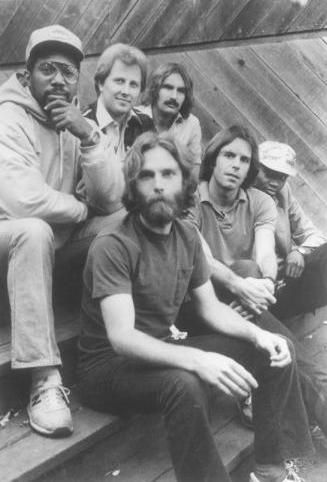
(Bobby and the Midnites press photo from 1981 with Brent Mydland and Matthew Kelly)
Those Ibanez cowboy guitars that you and Weir played are some of the best looking guitars to ever come down the pike. What can you tell me about them?
At some point in 1978 Ibanez wanted me to play their guitars and said they would build me anything I wanted. I couldn’t resist the offer. Hasselberger and I had become great friends and I had a sense of total commitment from them to make the very best instruments and effects in the world. I asked them to make me a guitar like Weir’s cowboy fancy with several alterations. I was very into the Zebra wood Tele that Wayne Charvel and I had made and I was also proud of the Yamaha SG2000 I, along with some of L.A.’s top studio musicians, had helped Yamaha design. I’d been trying to create a Tele/Strat/Les Paul combo in one guitar, for years, and we joined forces to make that dream come true. So I gave them my input on the cowboy guitar that Weir had already developed with them — he had already designed one and it was a great start. I wound up with a modified version of that guitar that included my own pickup configuration and some other changes. I actually had two of them made — my original version and then another one that had some improvements.
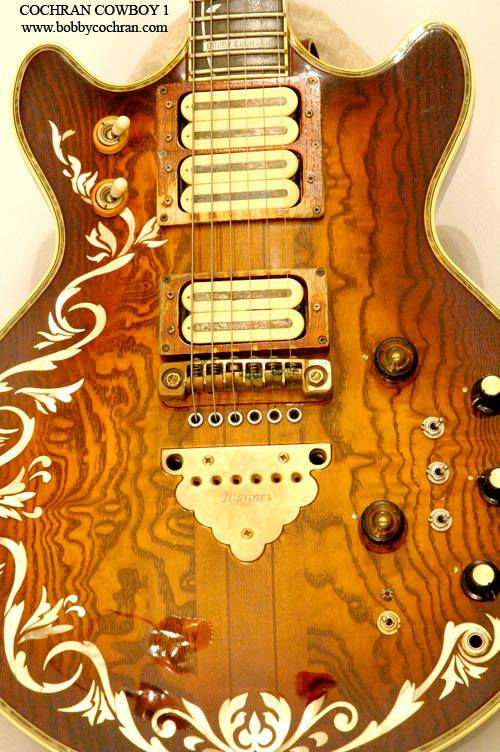
(Bobby’s first guitar collaboration with Ibanez, the Cochran Cowboy 1)
I remember working with a Japanese tech from Ibanez to try and get more tension on the bridge so that the guitar would have a sound closer to my Tele. He machined the brass bridge for me right on the spot one day at the factory. The bridge allowed for a more severe string angle to create the proper string tension. It’s hard to get a guitar perfectly in tune and to get the intonation right, but once they are set up by the right guy they can be wonderful. We ended up replacing the sustain block with ash and moving the switches to the bottom of the guitar. The shape of the horns [between my first and second versions of the guitar] is ever so slightly different too. And there are some differences in the inlay. The headstock size got smaller too. What’s cool about these guitars is that there are 63 switch positions available, two three-band EQs, and in the pre-amp off position the 20 db gain knob becomes a tone control to roll of highs. My second cowboy is about an inch shorter due to the smaller headstock. It is also a little lighter due to the thinner body. I gave them back to Ibanez to help them model the Weir reissue that was released several years back.

(Ibanez Cowboy Fancy reissue circa 2006)
Ibanez made some great stuff. They also provided my main rack mount effects system that I used with the Midnites.
How do you feel about the music that you and Weir created during your time together?
Bob’s side projects were kind of a hobby for him, a way for him to explore his musical interests outside of the Grateful Dead. But I can tell you that it turned out to be much more than that. Weir and I had something magical and it really took off. People who knew him well said that he really broke some new ground with me and that he flourished and developed. He was happy. There was a lot of smiling on stage and some really fun times with all the guys in our bands. I didn’t really know his music before I played with him. I remember driving in Hasselberger’s Porsche. He had a tape playing and was telling me about Weir. We were listening to the song Truckin’.” He said this is Bob Weir singing. I didn’t even know it was the Dead (laughs).

(Bob Weir and Bobby Cochran dueling Ibanez Cowboys. Photo courtesy of Steve Whalen)
You have become a part of the extended Grateful Dead family. How do you feel about Deadheads?
I love them. I love the inspiration of the audience, the free flow of energy. It’s an amazing thing. Weir’s audience is great. They want the inspired moment to happen. They are open to that possibility and always ready to jump on board.
Do you think you’ll play with Weir again?
I know so. I often play with him when he visits Nashville and I’ve been out to visit him a few times in Marin. I recently got to tour his set-up at TRI studios and I was very impressed by what he has built there. It was really nice hanging out with him again. There’s a lot we could do, be it in an electric or acoustic format. We’ve got a nice body of songs that we already know and we could bring all of our latest influences to the table as well. It’s always fun to play with him. I think we interact in a way that continues to be something great. We articulate a nice sound and take a journey of intensity. I know what he’s capable of. He’s a real talent.
How long have you been in Nashville now and what are you up to these days?
I’ve been based out of Nashville for about 20 years now. I opened a studio there and I also got hired to do my “Rock and Roll Forever” show so I stayed. A few days after I had put the money down on my house, I got a call from a client to produce their next album. The only problem, they said, is we have to do it in Nashville. They didn’t know I was moving there. I had 30 days to relocate all my recording equipment and prepare to start working on their CD. So that worked out well. I still perform on the West Coast and tour in Europe. I also do solo acoustic guitar gigs that feature my latest work. It’s a cross between Chet Atkins finger style mixed with blues, rock, and country lead playing. Writing my book and working on my various enterprises occupies a lot of my time. I’m living life and enjoying the ride so to speak. I’m paying attention as life unfolds and bringing my joy to circumstances rather than allowing circumstances to dictate my joy.


Comments